 StockDrifts
When CEOs bet big on their own stock, liquid names paid and thin ones did not
A chief executive buying a large slice of their own company is the insider trade people remember. We followed 19,978 of them for a year. The size of the bet relative to the CEO's stake mattered, the dollar amount did not, and the same big bet that did well in a liquid stock did badly in a thinly traded one. Most of the payoff arrived in one crash.
Big CEO bets, liquid stocks
+28.8%
Index +19.9% · 363 purchases
Big CEO bets, thin stocks
+9.2%
Index +14.9% · 1,052 purchases
CEO buys of $1M+, liquid stocks
+7.5%
Index +16.3% · 764 purchases
All CEO purchases
+16.5%
Index +15.0% · typical +1.9%
The reading in 30 seconds
- In stocks trading $10M+ a day, CEO purchases that raised the CEO's stake by 25% or more returned +28.8% over the next year, against +19.9% for their index. Smaller CEO purchases in the same stocks returned +15.5% against +18.0%.
- The same kind of bet in a thinly traded stock returned +9.2% against +14.9%, and in 2021-2025 −17.2% against +6.1%. 22% of those bets lost half their value within a year.
- Dollars were the wrong yardstick: CEO purchases over $1M in liquid stocks returned +7.5% against +16.3%. And the best big bets of the decade were made in March 2020; without 2020, liquid big bets returned +3.3% against +10.5%.
01 / CEOs in general
A CEO's purchase is not the strongest insider signal
Across 19,978 open-market purchases by chief executives filed from 2016 to September 2025, the average stock returned +16.5% over the following twelve months against +15.0% for an index of same-size companies. Directors did better: +19.1% against +15.5%. The typical CEO purchase returned +1.9%, the typical director purchase +7.2%.
A CEO's purchase is also a message, and it is often sent after bad news, when the stock has already fallen and the board wants to show confidence. A CEO's first open-market purchase in years sounds like a stronger signal. It was not: first purchases since 2016 returned +13.2% against +13.3%, while CEOs who had bought before returned +17.8% against +14.3%.
02 / Size of the bet
What counts is the share of the stake, and where the stock trades
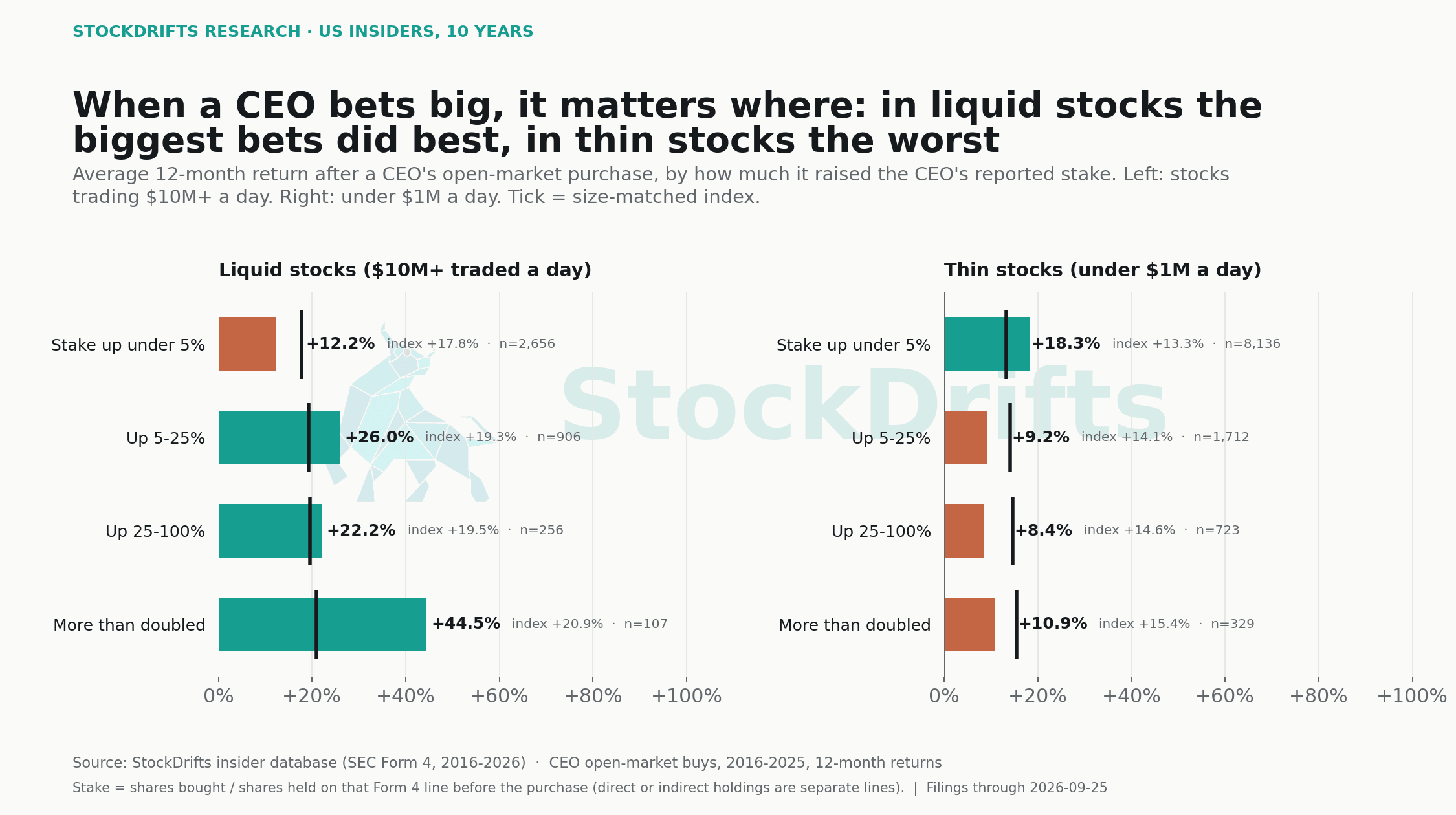
Form 4 does not show a CEO's net worth, but each line shows the shares held after the trade, so we can measure how much a purchase added to what the CEO already held on that line. Split that way, and split again by how easily the stock trades, the pattern is clear. In liquid stocks the return rose with the size of the bet: purchases that added under 5% to the stake returned +12.2% against +17.8% for their index, purchases that more than doubled it returned +44.5% against +20.9%.
In thinly traded stocks the order reversed. Small top-ups returned +18.3% against +13.3%; purchases that more than doubled the stake returned +10.9% against +15.4%, with a typical result of −10.9%. A big bet by the CEO of a small, illiquid company is often a rescue: buying into a financing, or supporting a stock that the market is abandoning for a reason.
| Stake increase | Liquid: return | Liquid: index | Liquid: purchases | Thin: return | Thin: index | Thin: purchases |
|---|---|---|---|---|---|---|
| under +5% | +12.2% | +17.8% | 2,656 | +18.3% | +13.3% | 8,136 |
| +5% to +25% | +26.0% | +19.3% | 906 | +9.2% | +14.1% | 1,712 |
| +25% to +100% | +22.2% | +19.5% | 256 | +8.4% | +14.6% | 723 |
| more than doubled | +44.5% | +20.9% | 107 | +10.9% | +15.4% | 329 |
03 / Dollars against stake
A $1M purchase is not a big bet by itself
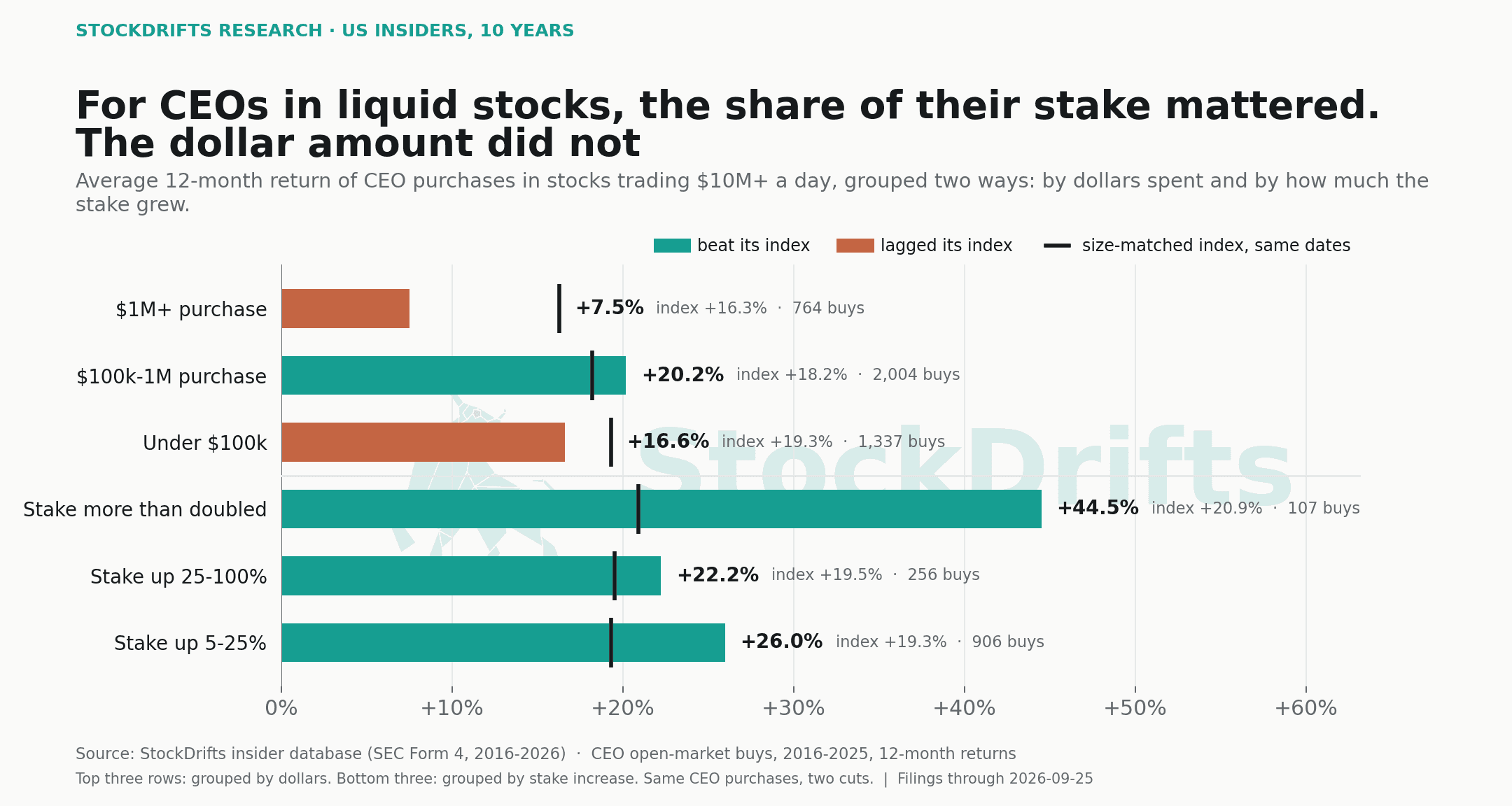
Headlines lead with the dollar amount. The returns do not follow it. In liquid stocks, CEO purchases of more than $1M returned +7.5% against +16.3% for their index, worse than purchases of $100k to $1M (+20.2% against +18.2%). Large dollar purchases come mostly from CEOs of large companies who already own a great deal of stock, for whom $1M is a small addition. The share of the stake captures conviction; the dollar figure captures wealth.
04 / Where the payoff came from
The best CEO bets of the decade were made in one month
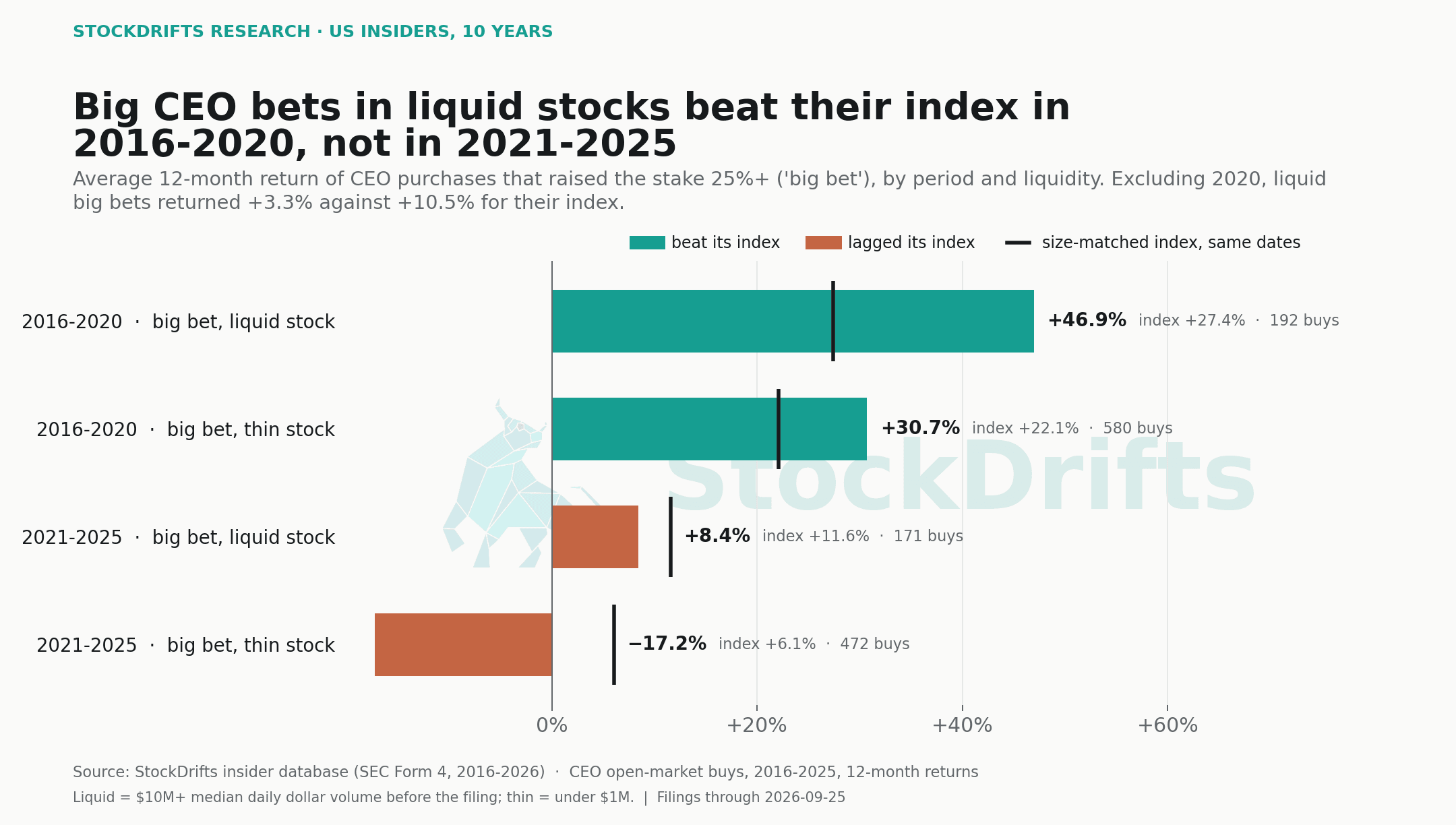
Split the big bets by period and the liquid-stock advantage is concentrated in 2016 to 2020. Liquid big bets filed in those years returned +46.9% against +27.4% for their index; in 2021 to 2025, +8.4% against +11.6%. Without 2020 the liquid big bets returned +3.3% against +10.5%. In the later period they still did better than smaller CEO purchases in the same stocks (+6.0%), and far better than thin-stock big bets (−17.2%).
Seven of the eight best liquid big bets were filed in March 2020, when CEOs of energy, leisure and retail companies bought stock that had halved in weeks. Joseph Foran of Matador Resources more than doubled his stake on March 16, 2020; the stock returned +1676.3% over the next twelve months. The lesson is less about CEOs than about timing: a CEO's big bet made into a market-wide panic was the best insider trade of the period.
| Company | CEO | Filed | Amount | Stake increase | 12-month return | Index |
|---|---|---|---|---|---|---|
| Matador Resources Co (MTDR) | Joseph Wm Foran | 2020-03-16 | $479k | more than doubled | +1676.3% | +117.4% |
| Tivity Health, Inc. (TVTY) | Robert J Greczyn Jr | 2020-03-17 | $194k | +65% | +788.8% | +109.3% |
| Hibbett Sports Inc (HIBB) | Michael E Longo | 2020-03-24 | $135k | more than doubled | +555.1% | +87.1% |
| Camping World Holdings, Inc. (CWH) | Marcus Lemonis | 2020-03-12 | $633k | +33% | +546.8% | +98.3% |
| Terns Pharmaceuticals, Inc. (TERN) | Amy L. Burroughs | 2024-12-09 | $110k | more than doubled | +544.7% | +3.4% |
| Qurate Retail, Inc. (QRTEA) | Michael A George | 2020-03-09 | $3m | +28% | +494.5% | +54.5% |
| DCP Midstream, LP (DCP) | Wouter T. van Kempen | 2020-03-10 | $498k | more than doubled | +317.5% | +67.9% |
| MGM Resorts International (MGM) | William Hornbuckle | 2020-03-31 | $496k | +38% | +237.4% | +97.6% |
05 / When big bets fail
A big bet cannot save a business that is failing
The worst big bets in liquid stocks were CEOs backing companies that later filed for bankruptcy (Tailored Brands in 2019, Party City in 2018, Loyalty Ventures in 2021) or kept issuing new shares (FuelCell Energy in 2021). Harold Hamm put $34M into Continental Resources in March 2019; the stock fell 77% over the next year. In liquid stocks 10% of big bets lost half their value within twelve months. In thinly traded stocks 22% did.
| Company | CEO | Filed | Amount | Stake increase | 12-month return | Index |
|---|---|---|---|---|---|---|
| Tailored Brands Inc (TLRD) | Dinesh S. Lathi | 2019-09-17 | $72k | +41% | −93.3% | −1.8% |
| Loyalty Ventures Inc. (LYLT) | Charles L Horn | 2021-11-15 | $100k | +32% | −93.1% | −12.7% |
| Aclaris Therapeutics, Inc. (ACRS) | Douglas J. Manion | 2023-03-17 | $50k | +97% | −85.5% | +18.3% |
| Party City Holdco Inc. (PRTY) | James M Harrison | 2018-11-13 | $505k | more than doubled | −83.9% | +9.8% |
| FuelCell Energy Inc (FCEL) | Jason Few | 2021-01-26 | $198k | +99% | −83.5% | +16.7% |
| Continental Resources, Inc (CLR) | Harold Hamm | 2019-03-26 | $34m | +30% | −77.2% | −4.7% |
06 / This quarter
CEO bets filed since August 1, 2026
Every CEO purchase filed from August 1 to September 25, 2026 in a stock trading $10M or more a day that raised the CEO's holding on its Form 4 line by 25% or more. These have no track record yet; the history above says what similar purchases did on average, not what these will do. Stake increases are measured on the line the purchase was reported on: Grab's Anthony Tan, for example, holds much of his stake in Class B shares and through entities, so the direct Class A line he bought into grew far more than his total holding.
| Company | CEO | Filed | Purchases | Amount | Avg. price | Stake increase |
|---|---|---|---|---|---|---|
| Grab Holdings Ltd (GRAB) | Anthony Ping Yeow Tan | September 21 | 1 | $30m | $2.89 | more than doubled |
| EquipmentShare.com Inc (EQPT) | Jabbok Schlacks | September 1 to September 16 | 3 | $1m | $17.56 | +50% |
| Upstart Holdings, Inc. (UPST) | Paul Gu | September 10 | 1 | $1m | $25.55 | +63% |
| Destiny Tech100 Inc. (DXYZ) | Sohail Prasad | September 8 | 1 | $2m | $31.56 | more than doubled |
| SiteOne Landscape Supply, Inc. (SITE) | Doug Black | August 28 | 1 | $481k | $96.13 | +63% |
| Kura Oncology, Inc. (KURA) | Troy Edward Wilson | August 17 to August 24 | 2 | $2m | $11.76 | +36% |
| Matador Resources Co (MTDR) | Joseph Wm Foran | August 12 to August 14 | 2 | $975k | $51.76 | +96% |
| Altimmune, Inc. (ALT) | Jerome Benedict Durso | August 13 | 1 | $44k | $2.95 | +32% |
| Harley-Davidson, Inc. (HOG) | Artie Starrs | August 11 | 1 | $259k | $25.89 | +67% |
| Neogen Corp (NEOG) | Mikheal Nassif | August 6 | 1 | $4k | $11.81 | +53% |
The larger-dollar CEO purchases of the same weeks, which added less than a quarter to the CEO's stake, are below. On the decade's evidence these deserve less weight than their size suggests. The largest were Ryan Cohen at GameStop ($47m in two purchases), Lachlan Murdoch at Fox, Dara Khosrowshahi at Uber and Lip-Bu Tan at Intel.
| Company | CEO | Last filed | Amount | Stake increase |
|---|---|---|---|---|
| GameStop Corp. (GME) | Ryan Cohen | September 21 | $47m | +3% |
| Fox Corp (FOX) | Lachlan K Murdoch | September 16 | $10m | +12% |
| Uber Technologies, Inc (UBER) | Dara Khosrowshahi | September 10 | $10m | +11% |
| Intel Corp (INTC) | Lip-Bu Tan | August 14 | $10m | +9% |
| Klarna Group plc (KLAR) | Sebastian Siemiatkowski | August 28 | $10m | +3% |
| Boston Scientific Corp (BSX) | Michael F Mahoney | August 5 | $9m | +13% |
| Cardinal Infrastructure Group Inc. (CDNL) | Jeremy Simmons Spivey | August 17 | $3m | new line |
| Inhibrx Biosciences, Inc. (INBX) | Mark Lappe | September 8 | $3m | +4% |
| Aptiv PLC (APTV) | Kevin P Clark | August 11 | $3m | +9% |
| CoStar Group, Inc. (CSGP) | Andrew C Florance | August 5 | $2m | +5% |
| Fortune Brands Innovations, Inc. (FBIN) | Jesse G Singh | August 10 | $2m | new line |
| Primo Brands Corp (PRMB) | Eric J Foss | August 12 | $2m | +17% |
07 / How to use it
Three filters before following a CEO
Measure the bet against the stake. A purchase that adds a quarter or more to what the CEO holds is a different event from a $1M top-up by a CEO who owns $300M of stock.
Check the stock trades. The same big bet returned +28.8% in liquid stocks and +9.2% in thin ones. Below $1M a day, treat a CEO's big purchase as a warning to find out what the company needs the support for.
Look at the market around it. The best CEO bets were made when the whole market was being sold. When insiders across the market are buying too, as the buy/sell ratio shows, a CEO's big bet in a liquid stock has had its best record. When several insiders buy together, see cluster buying.
08 / Explore the evidence
Download the tables
09 / Questions
Questions this study answers
- Is it a good sign when a CEO buys shares of their own company?
- Somewhat, and it depends on the stock. Across 19,978 CEO open-market purchases from 2016 to 2025, the average stock returned +16.5% over the next year against +15.0% for a size-matched index, and the typical purchase returned +1.9%. CEO purchases that raised the CEO's stake by 25% or more returned +28.8% in stocks trading $10M+ a day, against +19.9% for their index, and +9.2% in stocks trading under $1M a day, against +14.9%.
- How much does a CEO need to buy for it to matter?
- Measure the purchase against the CEO's existing stake, not in dollars. In liquid stocks, CEO purchases over $1M returned +7.5% on average against +16.3% for their index, while purchases that more than doubled the CEO's stake returned +44.5% against +20.9%. A $1M purchase is small for a CEO with $200M of stock and large for one with $2M.
- Do CEO stock purchases predict returns better than director purchases?
- No. Directors' purchases returned +19.1% on average against +15.5% for their index; CEOs' purchases +16.5% against +15.0%. The typical director purchase returned +7.2%, the typical CEO purchase +1.9%. CEO purchases are more often made to signal confidence after bad news, which the market can read too.
- Which CEOs are buying their own stock right now?
- Since August 1, 2026, 10 CEOs of stocks trading $10M+ a day made purchases that raised their reported stake by 25% or more, and 26 more bought $1M or more with a smaller share of their stake. Both lists are in section 6.
This study describes past trades and what their stocks did afterwards. It is not a recommendation to buy or sell any security. Averages over thousands of trades say nothing certain about the next one, and the trades named here are examples, not picks.
More in this series
- Ten years of insider buying: what 113,117 Form 4 purchases returned, and where the returns came fromOriginal Research · September 29, 2026
- Cluster buying: what happened when several insiders bought the same stockOriginal Research · September 29, 2026
- The insider buy/sell ratio: the weeks insiders called the market, and the crashes they missedOriginal Research · September 29, 2026
- The microcap trap: falling knives, insider selling and the rules that did not payOriginal Research · September 29, 2026