 StockDrifts
The more insiders bought a liquid stock together, the more it returned. Most of that came in 2016-2020
When a company's CEO, CFO and three directors all buy in the same month, it reads like conviction. We counted 49,828 stock-months of insider buying, once each, and followed them for a year. In stocks that trade, bigger clusters meant bigger returns. In thinly traded stocks they did not, and after 2020 the advantage all but disappeared.
5+ insiders, liquid stocks
+35.4%
Index +25.2% · 665 stock-months
1 insider, liquid stocks
+17.4%
Index +15.2% · 8,189 stock-months
5+ insiders, thin stocks
+15.2%
Index +14.8% · 1,510 stock-months
5+ insiders, liquid, 2021-2025
+12.1%
Index +12.4% · 288 stock-months
The reading in 30 seconds
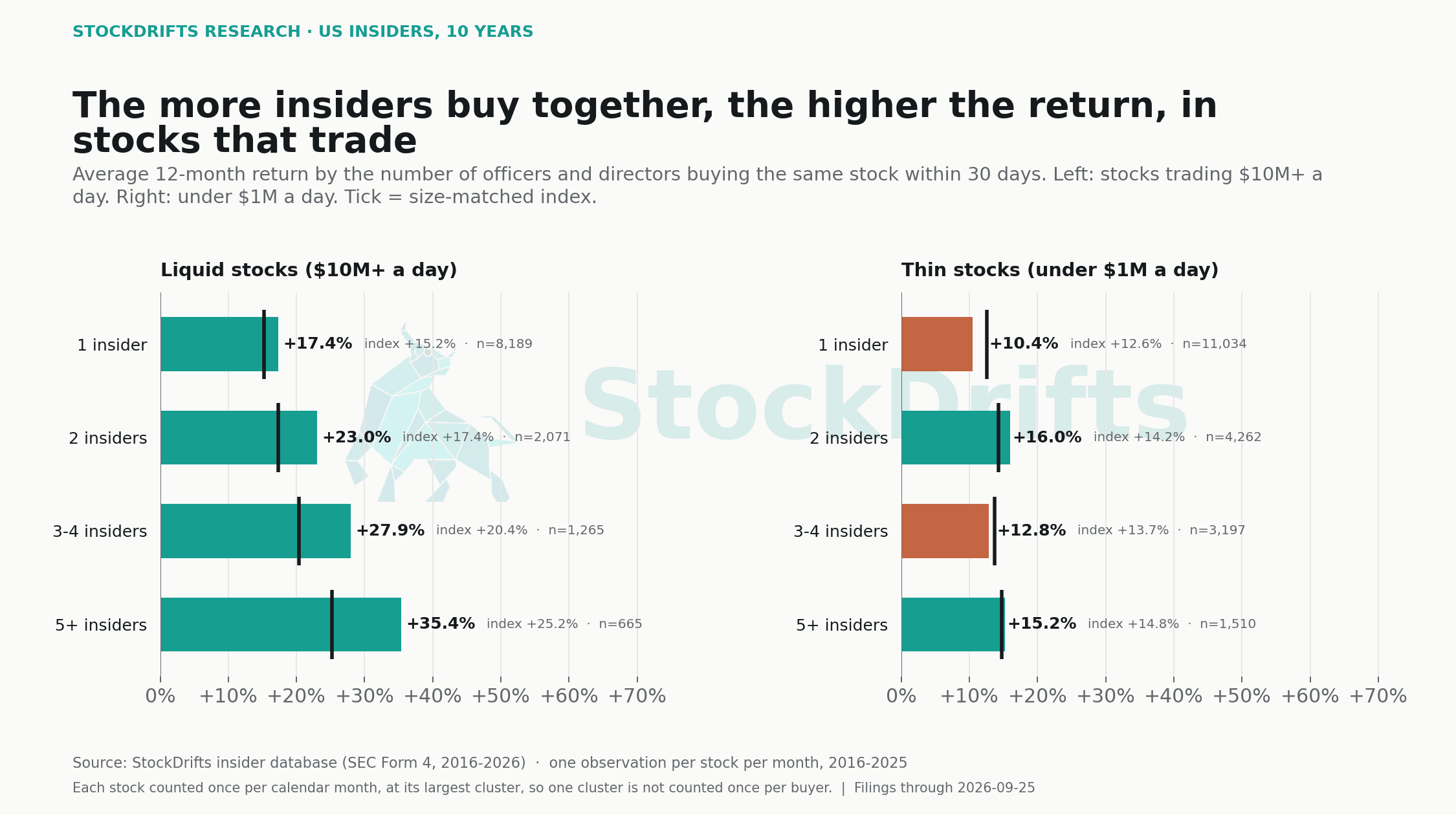
- In stocks trading $10M or more a day, returns rose with the number of insiders buying: +17.4% for one, +23.0% for two, +27.9% for three or four, +35.4% for five or more, against indexes between +15.2% and +25.2%.
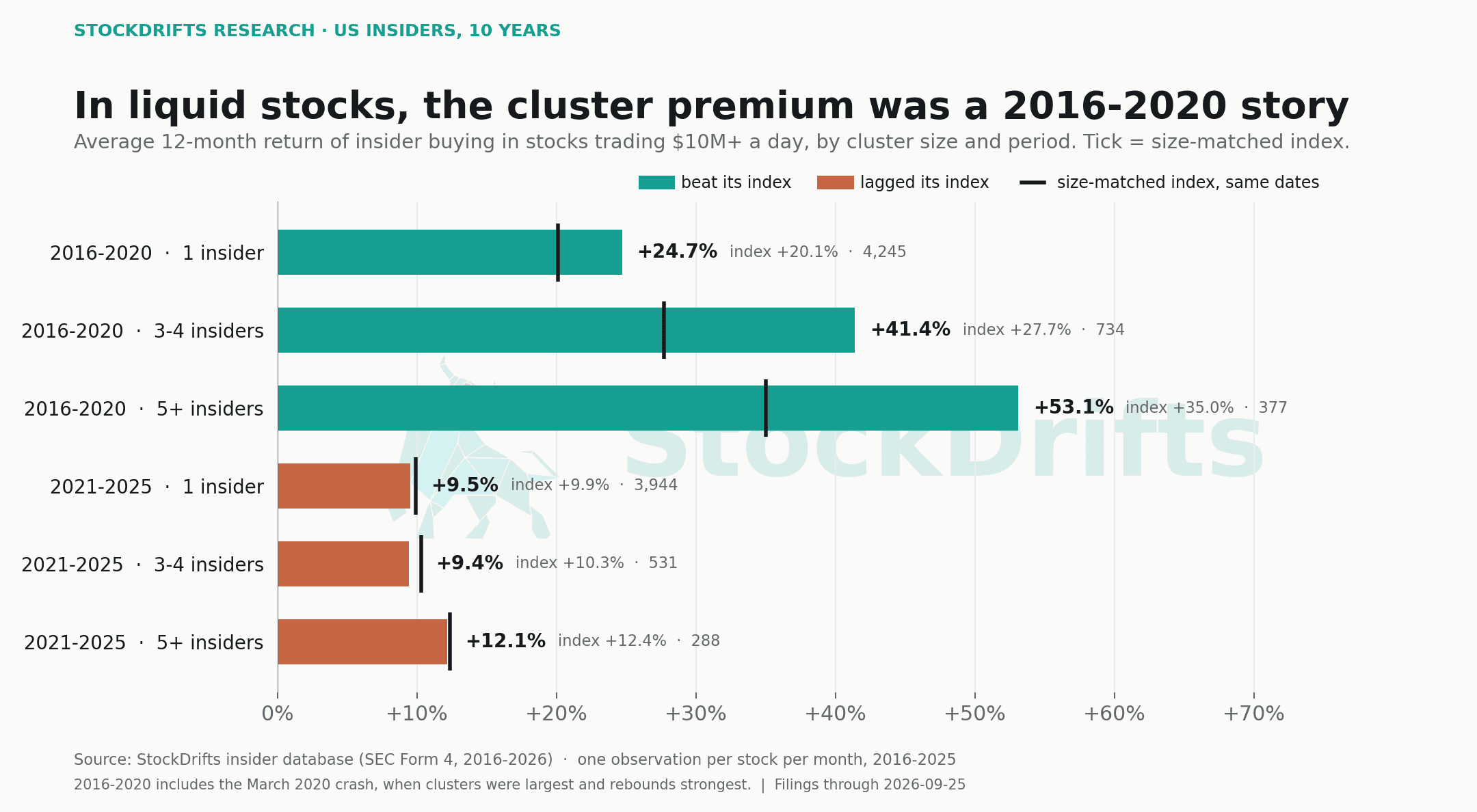
- The advantage was earned in 2016-2020, when five-plus clusters in liquid stocks returned +53.1% against +35.0%. In 2021-2025 they returned +12.1% against +12.4%. Without 2020, clusters of three or more in liquid stocks trailed their index.
- In thinly traded stocks, clusters of five or more returned +15.2% against +14.8%: no better than the index. Bigger clusters produce bigger winners, not more frequent ones; the share that beat their index stayed in the mid-40s.
01 / Counting clusters honestly
Why most cluster statistics are inflated
Cluster buying is easy to overcount. If five directors buy in the same week and each purchase is scored as a separate trade, a single good cluster enters the statistics five times. And when a fund, its general partner and its representative on the board each report the same purchase, one trade looks like a three-person cluster. Both happen in raw Form 4 data.
We count each stock once per calendar month, at the largest cluster it reached, and count a jointly reported purchase once. That leaves 49,828 stock-months with a full year of returns. Counted this way, clusters of five or more returned +22.2% on average against +18.4% for their index, and single-insider months +14.1% against +13.6%. The difference is real but smaller than trade-by-trade counts suggest.
| Insiders buying within 30 days | Stock-months | Average return | Size-matched index | Typical (median) | Beat the index |
|---|---|---|---|---|---|
| 1 insider | 26,410 | +14.1% | +13.6% | +5.6% | 43% |
| 2 insiders | 8,671 | +18.7% | +15.3% | +6.5% | 44% |
| 3-4 insiders | 6,056 | +18.6% | +16.0% | +5.7% | 43% |
| 5+ insiders | 2,958 | +22.2% | +18.4% | +8.3% | 45% |
02 / Liquidity
Clusters worked in stocks that trade
Split by how much of the stock trades each day and the effect sorts itself out. In stocks trading $10M or more a day, the average return climbed from +17.4% for a single insider to +35.4% for five or more, and every cluster size beat its index. Mid-liquidity stocks ($1M to $10M a day) showed the same shape, smaller: +16.0% to +24.6%. In stocks trading under $1M a day the count made little difference: one insider +10.4% against +12.6%, five or more +15.2% against +14.8%.
In small, illiquid companies a cluster is often a financing: the board buying into a private placement to keep the company going. That is loyalty, not information about the next year.
03 / Then and now
The cluster premium was a 2016-2020 story
Split the liquid-stock clusters by period. In 2016-2020, five-plus clusters returned +53.1% against +35.0% for their index and three-to-four clusters +41.4% against +27.7%. In 2021-2025 the same clusters returned +12.1% and +9.4%, against indexes of +12.4% and +10.3%. Without 2020, clusters of three or more in liquid stocks returned +8.5% against +11.2%, while single insiders returned +10.5% against +10.4%.
The biggest clusters of the decade formed in March 2020, when boards across energy, leisure and retail bought into the crash, and the rebound that followed produced most of the premium. Outside a market-wide panic, a cluster has told you less. The buy/sell ratio study shows how to recognise those moments as they happen.
04 / Who is in the cluster
The count mattered more than the names
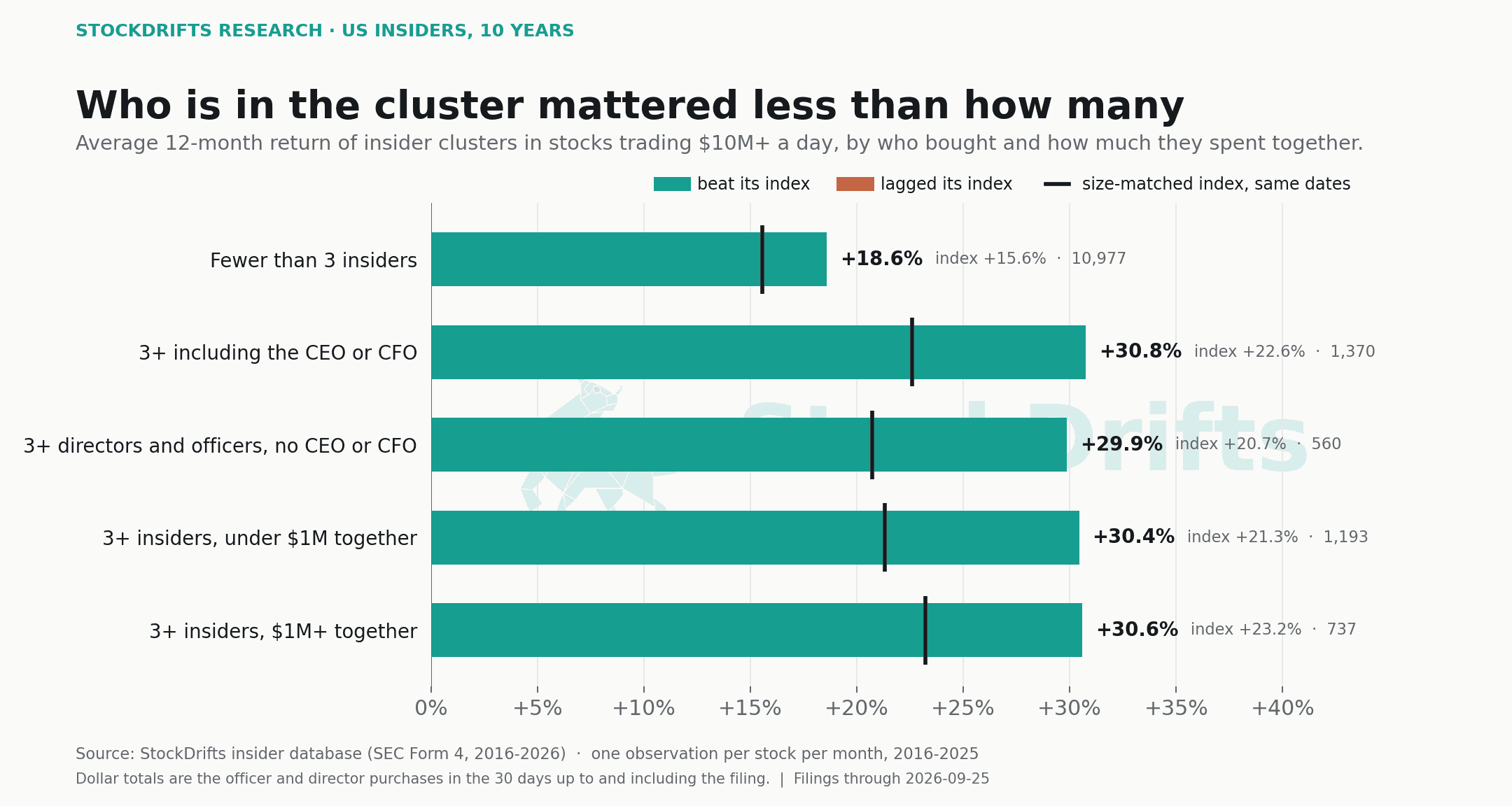
A cluster that includes the CEO or CFO sounds stronger than one made up of directors. It was not. In liquid stocks, clusters of three or more that included the CEO or CFO returned +30.8% against +22.6% for their index; clusters of directors and other officers without them returned +29.9% against +20.7%, with a higher typical result (+14.9% against +9.4%). The money behind the cluster did not separate them either: clusters that spent $1M or more together returned +30.6%, clusters that spent less +30.4%.
05 / The best and worst clusters
Eight of the best were in the spring of 2020
The largest liquid-stock clusters with the best following years all formed in March and April 2020: sixteen Matador Resources insiders, ten at Ovintiv and Tivity Health, nine at Oceaneering. The worst were clusters that could not stop a decline: five Enviva insiders in May 2023 before its bankruptcy, ten at SelectQuote in 2021, thirteen at Pennsylvania REIT in 2019.
| Company | Month | Insiders | Bought together | 12-month return | Index |
|---|---|---|---|---|---|
| Matador Resources Co (MTDR) | Mar 2020 | 16 | $2m | +1776.7% | +128.5% |
| Camping World Holdings, Inc. (CWH) | Mar 2020 | 5 | $2m | +978.0% | +128.5% |
| Tivity Health, Inc. (TVTY) | Mar 2020 | 10 | $7m | +788.8% | +109.3% |
| Ovintiv Inc. (OVV) | Mar 2020 | 10 | $1m | +764.7% | +99.4% |
| SM Energy Co (SM) | Mar 2020 | 6 | $490k | +720.7% | +98.3% |
| Oceaneering International Inc (OII) | Mar 2020 | 9 | $377k | +496.9% | +117.4% |
| Hibbett Sports Inc (HIBB) | Apr 2020 | 5 | $310k | +460.6% | +83.5% |
| DCP Midstream, LP (DCP) | Mar 2020 | 7 | $1m | +414.2% | +101.2% |
| Company | Month | Insiders | Bought together | 12-month return | Index |
|---|---|---|---|---|---|
| Enviva Inc. (EVA) | May 2023 | 5 | $3m | −93.3% | +21.2% |
| SelectQuote, Inc. (SLQT) | Sep 2021 | 10 | $8m | −91.6% | −8.0% |
| McDermott International Inc (MDR) | Nov 2018 | 7 | $2m | −90.1% | +17.2% |
| Pennsylvania Real Estate Investment Trust (PEI) | Sep 2019 | 13 | $824k | −88.9% | −5.5% |
| Encana Corp (ECA) | Jun 2019 | 5 | $597k | −87.6% | +8.8% |
06 / This month
Clusters of three or more, August 15 to September 25, 2026
Every stock trading $10M or more a day in which three or more officers and directors filed open-market purchases within 30 days, with the latest purchase filed from August 15 to September 25, 2026. The history above describes what similar clusters did on average; it is not a forecast for any of these. Amrize, spun out of Holcim in 2025, had the largest: eleven insiders.
| Company | Insiders in 30 days | Bought together | CEO or CFO in it | Latest filing | Traded a day |
|---|---|---|---|---|---|
| Amrize Ltd (AMRZ) | 11 | $3m | Yes | September 3 | $170M |
| Cardinal Infrastructure Group Inc. (CDNL) | 7 | $9m | Yes | August 18 | $27M |
| Star Bulk Carriers Corp. (SBLK) | 7 | $5m | Yes | September 17 | $53M |
| Dick's Sporting Goods, Inc. (DKS) | 6 | $5m | Yes | September 24 | $448M |
| Wix.com Ltd. (WIX) | 6 | $186k | Yes | September 2 | $100M |
| Elanco Animal Health Inc (ELAN) | 5 | $1m | Yes | August 21 | $161M |
| GameStop Corp. (GME) | 4 | $49m | Yes | September 21 | $154M |
| Boston Scientific Corp (BSX) | 4 | $9m | Yes | August 26 | $946M |
| Aptiv PLC (APTV) | 4 | $8m | Yes | August 17 | $181M |
| Ameresco, Inc. (AMRC) | 4 | $2m | Yes | September 1 | $15M |
| United States Antimony Corp (UAMY) | 4 | $299k | Yes | September 2 | $40M |
| Inhibrx Biosciences, Inc. (INBX) | 3 | $4m | Yes | September 23 | $33M |
| Agree Realty Corp (ADC) | 3 | $4m | Yes | September 23 | $97M |
| Celsius Holdings, Inc. (CELH) | 3 | $2m | Yes | September 16 | $240M |
| Cooper Companies, Inc. (COO) | 3 | $1m | No | September 15 | $127M |
| Matador Resources Co (MTDR) | 3 | $1m | Yes | August 31 | $104M |
| Karman Holdings Inc. (KRMN) | 3 | $1m | No | September 18 | $132M |
| AbCellera Biologics Inc. (ABCL) | 3 | $975k | Yes | August 18 | $33M |
| Resideo Technologies, Inc. (REZI) | 3 | $848k | Yes | August 18 | $48M |
| Dycom Industries Inc (DY) | 3 | $551k | Yes | September 24 | $186M |
| Limbach Holdings, Inc. (LMB) | 3 | $516k | No | September 16 | $20M |
| Matthews International Corp (MATW) | 3 | $235k | No | August 20 | $14M |
| Celanese Corp (CE) | 3 | $230k | Yes | August 17 | $72M |
| Community Financial System, Inc. (CBU) | 3 | $75k | No | September 10 | $11M |
07 / How to use it
Reading a cluster
Count people, once. Five insiders in a month is one event. Check that the names are different people, not a fund and its affiliates filing the same trade.
Require liquidity. The premium lived in stocks trading $10M or more a day. In thinly traded stocks a cluster was no better than a single purchase, and the microcap study shows why.
Weigh the market around it. Clusters that formed while insiders across the market were buying, as in March 2020, did best. In a calm market a cluster is a reason to research the company, not a reason to buy it. For single large purchases, see CEO big bets.
08 / Explore the evidence
Download the tables
09 / Questions
Questions this study answers
- What is insider cluster buying?
- Cluster buying is several insiders of the same company, such as the CEO, the CFO and board members, buying its stock on the open market within a short window. In this study a cluster is two or more officers or directors filing Form 4 purchases within 30 days, and each stock is counted once per month so that a five-person cluster is not counted five times.
- Is insider cluster buying a good signal?
- In liquid stocks, on average, yes. In stocks trading $10M or more a day, five or more insiders buying within 30 days was followed by a +35.4% average return over the next year, against +25.2% for a size-matched index; a single insider buying, +17.4% against +15.2%. In thinly traded stocks clusters made little difference. Most of the advantage was earned in 2016-2020, and in 2021-2025 clusters roughly matched their index.
- How many insiders buying at once is significant?
- Returns rose with the count in liquid stocks: one insider +17.4%, two +23.0%, three or four +27.9%, five or more +35.4% over the next 12 months. The share of clusters that beat their index barely moved (45% for one insider, 46% for five or more), so larger clusters produced bigger winners rather than more frequent ones.
- Which stocks have insider cluster buying right now?
- From mid-August to September 25, 2026, 24 stocks trading $10M or more a day had three or more officers and directors buying within 30 days. The largest clusters were Amrize Ltd (11 insiders), Cardinal Infrastructure Group Inc. (7 insiders), Star Bulk Carriers Corp. (7 insiders), Dick's Sporting Goods, Inc. (6 insiders). The full list is in section 6.
This study describes past trades and what their stocks did afterwards. It is not a recommendation to buy or sell any security. Averages over thousands of trades say nothing certain about the next one, and the trades named here are examples, not picks.
More in this series
- Ten years of insider buying: what 113,117 Form 4 purchases returned, and where the returns came fromOriginal Research · September 29, 2026
- When CEOs bet big on their own stock: liquid names paid, thin ones did notOriginal Research · September 29, 2026
- The insider buy/sell ratio: the weeks insiders called the market, and the crashes they missedOriginal Research · September 29, 2026
- The microcap trap: falling knives, insider selling and the rules that did not payOriginal Research · September 29, 2026